Inside This Issue
Volume 4, Issue 4December 2014
A Publication by the
2014 Officers and Directors
Tennessee Association of Drug Court Professionals
A New ImmunoassayFor Testing OpiateAbuse 2Acts ofKindness 2TADCPEvents 2Burch SaysFarewell 3The President’sCorner 3PerryRetires 4MembershipApplication 4
PresidentTracye BryantVice PresidentTracye BryantTreasurerBrad PriceSecretaryRick TaylorWest Tennessee DirectorAngela ParkersonMiddle Tennessee DirectorMike LewisEast Tennessee DirectorJudge Charles CernyAt Large DirectorsRon HanaverKevin BattsJill Barrett
F
OUNDERS
OF
THE
27
TH
J
UDICIAL
D
ISTRICT
R
ECOVERY
C
OURT
R
ETIRE
J
UDGE
W
ILLIAM
B. A
CREE
, J
R
.
AND
V
ERONICA
T
HORNTON
E
ND
C
AREERS
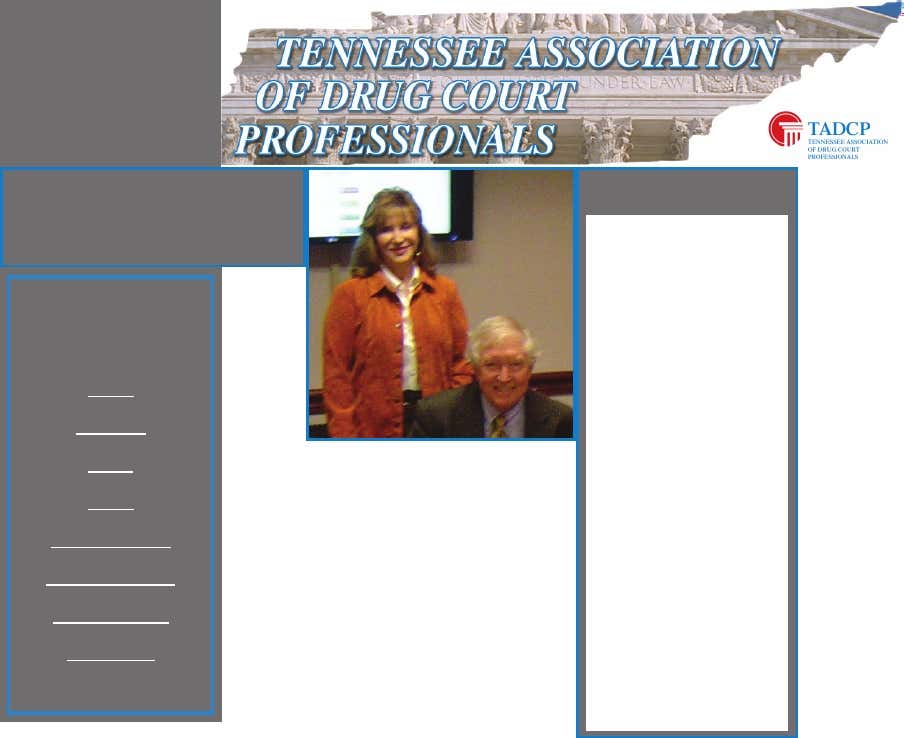
On September 1, 2014, both Circuit Court Judge William B. “Bill” Acree and Recovery Drug Court Coordinator Ms. Veronica Thornton retired from their long standing careers and their work with the 27th Judicial District Recovery Drug Court program. In 2001 Judge Acree, disillusioned by seeing the same faces continually appearing in his court decided to develop and imple-ment a Drug Court program for the 27th Judicial District which serves both Weakley and Obion counties. Ms. Veronica Thornton, the director for the Westate Corrections Agency in Union City Tennessee, without hesitation came on board, and agreed to serve as the program coordinator. It was in 2001 that the pair (Acree and Thornton) first discussed the drug court program. They became interest-ed enough in the statistical results they were being shown that they continued their investigation by traveling to Chico, California for initial introducto-ry training.Upon their return they began inter-viewing and selecting the drug court team. There has been little turn over since, many of the initial members having served con-tinually alongside them in this endeavor all these years. Before starting the court, the whole team traveled to Olympia, Washington for final intensive organizational instruction in early 2002 and opened the doors of that new recovery court later that year. It has flourished ever since.The team, under the leadership of these two stalwarts, made several crucial decisions early on. First, the team decided to meet each week at eight (8:00 a.m.) every Thursday morning – rain or shine. Second, they concluded that if they were going to meet every week, that early in the morning, and without extra pay, that another commitment must be made in order to make it worth that sacrifice. The team chose not to “cherry pick” par-ticipants, to not select easy compliers or certain graduates – to boost statistics. The team chose to go after the worst, the hard core offenders, the incorrigible and least likely to succeed. The team decided that reaching them was the only way the program would be perceived as or be truly significant. And finally, the first treatment provider, Dr. Johnny Welch convinced the team to use the MRT Step Program. These three decisions have prov-en providential.The 27th Judicial District Drug Court is a post plea felony treatment program targeting non-violent offenders suffering from severe substance abuse issues. Clients accepted into the program receive intensive treatment, intensive supervision, fre-quent drug screens, and continued judicial intervention. The mission of the Twenty-Seventh Judicial District is and has always been to reduce drug related crime in Weakley and Obion counties of rural West Tennessee, by reducing drug dependency among drug court clients.In 2008, Acree and Thornton working in collaboration with Weakley County General Sessions Judge Tommy Moore and the entire drug court team filed for certification status through the Office of Criminal Justice Programs and became a certified drug court. In 2009 Obion County General Sessions Judge Jimmy Smith joined the Recovery Drug Court team. As of July 30, 2014, 130 participants have graduated from the 27th Judicial District Recovery Drug Court program. There have been over 300 participants, 45 currently participating. Both Judge Acree and Ms. Thornton have left a legacy that the current drug court team intends to continue for years to come. The Recovery Drug Court team welcomes Honorable Jeff Parham who was elected as the Circuit Court Judge for the 27th Judicial District. Mr. Michael Walton, the Assistant Director for Westate Corrections and a veteran to the Drug Court program will take the helm as the new Recovery Drug Court Coordinator. Judge Acree modestly commented that the Recovery Court works because of the Team. He insisted that, had not all the people who have worked on that team not come on board, the Court would have faltered. He remarked, “I knew we had the makings of some-thing great when both, Sheriff Jerry Vastbinder and Sheriff Mike Wilson, and when DA Tommy Thomas and his staff, PD Joe Atnip and his staff, Veronica Thornton and her staff at Westate, Dr. Debra Gibson (UT Professor) as statistician/record keeper, Judges Moore and Smith and our Treatment Advisors all signed up and committed to it.” Judge Tommy Moore lauded Acree, noting his role in bring-ing the drug court to the area. “One of his great legacies will be the successful drug court program that he helped start 10 years ago. He insisted that we all receive training for the program and that we run the program exactly by the book as were trained to do. He and Ms. Thornton sold the Drug Court idea to the people who have now become our Steering Committee -- local law enforcement, County Commissioners, Attorneys, businessmen, the clergy and the lay people of the area.”Attorney General Tommy Thomas remarked, “We have been able to reduce the crime rate through this program and given these people a new lease on life. Many of them have not turned back to crime and now take care of their bills and their families. We all must hand it to Judge Acree and Ms. Thornton that they saw the potential that this program had ten years ago.”Public Defender Joe Atnip shared, “The program has brought the legal community together and has encouraged all of us to cooperate for the good of the District and to help fight; the scourge of drugs, the crime caused by drugs and the devastating effect these illegal substances have on lives and families.”General Sessions Judge Jimmy Smith concluded, “One of the reasons I decided to become a Judge was the opportunity I might have to participate in this incredible program and work alongside my colleagues (Judge Acree and Judge Moore) and the DA Tommy Thomas and PD Joe Atnip and others on the Drug Court Team to have an impact on making this District a better place and to help transform lives and families.” Judge Bill Acree finalized his interview with, “…It has been a rewarding part of my career to help create something that has helped so many people.”
Attorney General Tommy Thomas remarked, "...We all must hand it to Judge Acree and Ms. Thornton that they saw the potential that this program had ten years ago.
Page 2Tennessee Association of Drug Court Professionals
A N
EW
I
MMUNOASSAY
FOR
T
ESTING
O
PIATE
A
BUSE
A
CTS
OF
K
INDNESS
G
IBSON
C
OUNTY
R
ECOVERY
C
OURT
- T
RENTON
, T
ENNESSEE
The increasing prevalence of chronic pain continues to be a source of concern for healthcare providers. Health care profession-als have long recognized the potential for addiction and abuse of prescription opioids. In the past decade, a greater focus has been placed on pain management, which has led to a significant increase in the number of opioids prescribed and may have contributed to long-standing trends of abuse and addiction. A dichotomy exists in the realm of pain management between balancing the under-treat-ment of pain and the potential for opioid misuse. One of the treatments of choice for chronic pain involves strong medications such as opioids. Side effects of opioids include seda-tion, dizziness, nausea, vomiting, and constipation. These medica-tions often result in abuse, misuse, or diversions. Adding to the complexity of managing pain patients is the fact that these medica-tions are controlled substances and cannot be purchased over the counter, therefore have high street value. For all these reasons phy-sician are required to determine whether patients under their care are compliant with their medication regime, abusing their medica-tions, or diverting them for financial gain. Thus, managing pain patients with opioid therapy is a difficult and controversial issue.Urine drug testing (UDT) is one of the tools that clinicians use to monitor “medication behaviors” and avoid morbidity and mor-tality associated with opioids. UDT gives confidence to the physi-cian that the patient is following the medication regimen and is therefore getting the most benefit from their treatment. In addi-tion, UDT has been associated with forensic testing, often referred to as workplace testing, to detect illicit drug use in employees. Workplace UDT has traditionally focused on identifying the use of abused drugs including amphetamines (methamphetamine), cocaine, marijuana, phencyclidine (PCP), and heroin (opiates). Proposed Revisions to Testing for these drugs usually follows scheduled guidelines established by the Substance Abuse and Mental Health Services Administration (SAMHSA) (Federal Register, 2004). Analytically, the testing involves qualitative and semi-quantitative immunoassay screening followed by confirma-tion by mass spectrometry. Testing for patients on chronic opioid therapy is a different paradigm as both positive and negative results are important. Assays that are more sensitive and can determine both the parent drug and one or more of its metabolites are there-fore as important.In order for the physicians to have an exact indication of the medications the patients need to take a broader clinical laboratory UDT menu to accurately monitor the pain patient population. For example, a positive opiate test does not indicate whether the patient is on codeine, hydrocodone, morphine, or hydromorphone. Therefore, in order to establish compliance it is necessary for the physician to determine exactly which medication has been ingested and assure the patient is not taking additional opiates which could create an unsafe situation. The medications most commonly found in the urine of this population are clearly hydrocodone and oxycodone, followed by morphine and hydromorphone; codeine is not frequently prescribed for this population. Benzodiazepines are the next most prescribed group. Other opioid medications such as fentanyl, meperidine, tra-madol, and propoxyphene are less frequently used. The use of muscle relaxants, such as carisoprodol, are also commonly seen. Marijuana is by far the most prevalent among the illicit drugs, fol-lowed by cocaine and methamphetamine. The accurate interpreta-tion of test results thus requires an understanding of the usefulness and limitations of immunoassays, knowledge of opiate metabolism, and awareness of the expected ratios of the parent drug and its metabolites in urine. In addition, small amount of impurities in medications detectable by mass spectrometry can complicate the interpretation of UDT results. There are two aspects of drug abuse in the pain patient popula-tion; one is the use of illicit drugs, and the other more prevalent aspect is abuse of the prescribed and non-prescribed medications. Combined, these two facets of abuse may approach 20-30% of the patients on chronic opioid therapy. Based on this data alone, the use of UDT should be justified for pain patients. When monitoring for opioid medication compliance, the testing method should be able to differentiate between codeine, morphine, hydrocodone, norhydrocodone, and hydromorphone. The immunoassay test should also be able to differentiate between oxycodone, noroxyco-done, and oxymorphone. This will allow the physician to determine that the opiate the patient is taking is in fact the one being pre-scribed and that the patient is metabolizing the medication proper-ly. The most commonly abused opioid is hydrocodone, a frequent-ly prescribed pain medication. Hydrocodone is a semi-synthetic opioid prescribed for pain management and cough. It is the most commonly abused prescribed opioid, as determined by the data reported to the American Association of Poison Centers and DAWN. The increased incidence of deaths attributed to hydroco-done abuse is also a major concern. The International Narcotics Control Board reported that 99% of the worldwide hydrocodone supply in 2007 was consumed in the United States. Commercial hydrocodone preparations are always combined with another medi-cation to increase efficacy and reduce adverse effects. It is avail-able as a mixture with acetaminophen (Vicodin), aspirin (Lortab), ibuprofen (Vicoprofen) and antihistamines (Hyconine). Currently, four pharmaceutical companies are developing long acting formu-lations of hydrocodone. Of these, Zohydro ER® has been submit-ted to FDA for new drug consideration. The recommended starting therapeutic dose range for hydrocodone is 5–30 mg (one capsule) per day. Analgesic action of hydrocodone begins 20–30 minutes after taking it and lasts 4–8 hours. Hydrocodone is sometimes referred to as a “pro-drug” because the more active compound is the metabolite (hydromorphone), not the administered drug. Although, several specific immunoassays for drugs of abuse are commercially available, including an opiate immunoassay which detects several opioids simultaneously, its sensitivity to detect hydrocodone and its metabolites is much lower. This leads to increasing possibility of negative screening when the drug is pres-ent in urine. The objective was thus, to develop a specific homoge-neous enzyme immunoassay for the specific detection of hydroco-done and hydromorphone and its glucuronide in human urine.Thermo Fisher Scientific now offers the Thermo Scientific™ DRI® Hydrocodone/ Hydromporphone Immunoassay* with a 300 ng/mL cutoff and ± 25% Low and High Controls. The assay uses a highly specific monoclonal antibody that can detect hydrocodone, hydromorphone and hydromorphone -D-glucuronide. The assay range is 0 ng/mL to 1000 ng/mL. The reagents, calibrators and controls are liquid ready-to-use. The assay demonstrated 100% cross-reactivity to hydromor- phone and its glucuronide with minimal cross-reactivity to opiate compounds and other concomitantly taken drugs. No significant interference was observed from endogenous substances. Two hun-dred and sixty eight patient samples were tested by immunoassay and the results showed >90% agreement with LC-MS/MS.The assay is intended for the qualitative and semi-quantitative determination of hydrocodone and its metabolites in human urine and is compatible with most automated clinical analyzers. For more information about this product and other drugs of abuse immunoassays, go to www.thermoscientific.com/dignostics
Zohydro™ ER is a trademark of Zogenix, Inc. “Vicodin” is a registered trademark of Abbvie Inc. Corporation. “Lortab” is a registered trademark of UCB Pharma Inc. All other trademarks are the property of Thermo Fisher Scientific and its subsidiaries. * For Criminal Justice and Forensic Use Only and is for sale in the U.S.A. only. Author Wendy LocklinCommercial Marketing Manager Thermo Fisher Scientific
As we look forward to the Thanksgiving Session we wanted to share our gratitude with our community. We issued a challenge to our participants to do a “random act of kindness to a stranger”. Our folks did an amazing job and received blessings from their actions. As I tell our partici-pants all the time, they are no longer “jail material”. Our folks are great neighbors, friends, parents, employees and spouses. Here are their accounts of there “act of kindness”:
“I bought a man and woman some cold cuts from wal-mart because I saw them holding up a sign saying they were hungry. I also bought their dog some food!
Michael R. Phase 3
“I gathered up some of the clothes that my daughter can’t wear anymore and some jackets and donated them to our local Mustard Seed. It was a humbling experience for me. I also paid for a lady’s food behing me at McDonald’s.”
Tracy M. Hopeful candidate
“I donated clothes to our Helping Hands and Twice Blessed. I feel so good when I help another. I gave a co-worker a ride home who was waiting in the cold. I gave $16.00 to the Charlie Brown Fund, he is at Vanderbilt Hospital.”
Eden H. Phase 2
“Me and my dad were on our way to Milan and I stopped to help a lady who had a flat. So I changed it for her. It made me feel good”
Bradley W. Phase 2
“I went to Humboldt Wal-mart and helped an elderly couple put their groceries in their car. I told them I was in Recovery Court and now just want to help others.”
Zach E. Phase 2
“I stopped to help a lady who had a flat tire. She said I was the first one to stop and she had been there 45 min-utes.”
Lynn R. Phase 2
“ I work at Butt’s Food and we have homeless people up and down our street. I took a homeless man (John) to the Dodge Store bought him breakfast and found out he was an alcoholic so I gave him a copy of meetings in our area."
Kelsha R. Phase 3
“ I saw a homeless man at Little General in Humboldt and it was cold and raining. I went into the store and bought him a pack of smokes and gave it to him with a 10.00 bill. I hope he is ok today.”
Travis B. Phase 3
“ On my way to the AA meeting I gave a man a ride. I do this often and he don’t talk in the meeting but does on the way back home. It helps us both.”
Bryan C. Phase 2
“I gave my daughter clothes she couldn’t wear to this man’s granddaughter."
Katie W. Phase 4
“A woman who was dropped off at a meeting didn’t have a ride home. I gave her one. It felt good."
Sam G. Phase 3
“I donated my clothes I can’t wear. I’ve gained 27 pounds.”
Kim R. Phase 1
“I went into our local Dollar Store and a cashier named Sam was so kind to me. She mentioned she also had children. She was such a blessing to me I decided to help her. I went home and made a basket full of cookies, fruit etc and wrote her a note took it back to the store and left it at the register with her name on it. It was amazing to share this with my kids”
Mandi L. Phase 1. PS: this girl makes awesome baskets.
“I was riding down the road with my mom and noticed a woman ran her car off in a ditch. We stopped and I went to check on her and stayed with her until the police and ambulance got there.”
Cynric P. Phase 1
THE WORLD DOES NOT CHANGE BY GRANDJESTURES BUT SIMPLE ACTS OF KINDNESS.
Submitted by: Lori; Angie; Monica; Janice; Tom; Scott; Danny (Team Members)
T A D C P
E
VENTS
Mark Your Calendars!
2015 NADCP Conference
December 2-4, 2015
Embassy Suites & Conference CenterMurfreesboro, Tennessee
Registration Information Coming Soon!
Page 3Tennessee Association of Drug Court Professionals
TADCP M
EMBERS
E
NJOY
....
B
Y
T
RACYE
B
RYANT
•
C
ONTINUING
E
DUCATION
O
PPORTUNITIES
(NAADAC
AND
CLE)
•
A
NNUAL
TADCP C
ONFERENCE
•
Q
UARTERLY
N
EWSLETTER
•
R
EPRESENTATION
THROUGH
THE
TADCP L
EGISLATIVE
C
OMMITTEE
•
F
REE
AND
D
ISCOUNTED
T
RAINING
O
PPORTUNITIES
Hey everybody! It’s time for the December newsletter, which also means, it’s almost Christmas and very close to a New Year! 2015 is just around the corner!To start this quarter’s newsletter off, I know that you see its being written by me instead of Mary Schneider. For those of you that don’t know yet, Mary made the decision to retire! Yes Retire! Can you believe it? I know many of us are looking forward to that day when we can slow down a little bit, so I truly hope that Mary will be able to do that and move into her next adventure. I know grandkids are certainly part of that!I’ve been working with the Sumner County Recovery Court Program since 2003 and Mary was the first person I was introduced to. Her Program in Rutherford County was already well established and my Judge insisted that I go visit her and learn what I could. Mary was a great resource and always willing to help with advice and share informa-tion. Many of us in the field have watched Mary, along with many others work hard and long hours to help pro-mote Tennessee Recovery Courts and help move them for-ward in a stronger direction. The TADCP Board members and Recovery Court Professionals want to Thank Mary for her hard work and determination. Mary, you will never be forgotten and your work with Recovery Courts will always be remembered. We all wish you the very best!As we rapidly approach the State Conference in Murfreesboro Tennessee at the amazing Embassy Suites. I hope everyone is registered and reservations have been made (but here’s the link if you still need to do that: http://tadcpconference10.ezregister.com). I look forward to see-ing new faces and old ones! I think everyone is going to enjoy this year’s conference with its guest speakers and exhibitors. Every year I always learn something new that I can take back to my own program to help improve it. The conference is a time for Recovery Court Professionals to gather with others, share program stories and interact with each other, listen to what they are doing and what ideas they have and what is working for them. We all have the same 10 key components to follow but yet each one of our programs is unique in its own way. We all work very hard to help our participants to move forward in a positive direction. In doing that we need to also take care of ourselves. I feel the State Conference is a way for us to get revived and regenerated so we can go back to our own programs and look at what we are doing, what we need to improve on and what we are doing well! So get geared up to get revived and to enjoy the confer-ence, relax and maybe do a little Christmas shopping! See you there!
Regards,Tracye Bryant
T
HE
P
RESIDENT
’
S
C
ORNER
The 23rd Judicial District Drug Court bade a fond farewell to Circuit Court Judge Robert E. Burch last month. But it was not for long. You see, Judge Burch returned the fol-lowing week as a dedicated Drug Court Team Member, a role he intends to keep. The entire team breathed a deep sigh of relief as Judge Burch entered the courtroom that next Thursday night and took his regular seat in the jury room to participate in pre-court staffing.The team welcomed a new Drug Court Judge that night, Circuit Judge Suzanne Lockert-Mash. Judge Lockert-Mash is no stranger to Drug Court. The long-time prosecutor regularly recommended Drug Court to defendants and would help them navigate their way into the program. She fit right in, and noted appreciation to Judge Burch for staying on and acting as mentor to her in her new role in Drug Court.Judge Burch was at the helm when the Drug Court was established 14 years ago. Burch says Drug Court is one of the most rewarding things he does. He is enor-mously pleased with the accom- plishments of the program, and especially the lives that have been touched by Drug Court. The 23rd Judicial District includes Cheatham, Dickson, Houston, Humphreys, and Stewart Counties.Judge Burch says the most touching aspect of Drug Court for him is when he sees families reunited. He recalls a teenage girl once thanking him for “Giving me back my daddy.”Judge Burch earned his law degree from Vanderbilt University in 1972. He worked as an attorney, a commercial pilot, and a Juvenile Referee before coming to the bench 34 years ago. He was named Tennessee Trial Judge of the Year in 2002.
J
UDGE
R
OBERT
E. B
URCH
S
AYS
F
AREWELL
23
RD
D
ISTRICT
J
UDGE
R
ETIRES
, B
UT
S
TAYS
O
N
AS
T
EAM
M
EMBER