Inside This Issue
Volume 4, Issue 2 June 2014
A Publication by the
2014 Officersand Directors
Tennessee Association of Drug Court Professionals
TADCPUpdates2BeyondRhetoric2TADCPEvents22014 Recovery CourtCoordinator Training3The President’sCorner3Life SkillsProgram4MembershipApplication4
PresidentMary SchneiderVice PresidentTracye BryantTreasurerBrad PriceSecretaryRick TaylorWest Tennessee DirectorAngela ParkersonMiddle Tennessee DirectorMike LewisEast Tennessee DirectorJudge Charles CernyAt Large DirectorsRon HanaverKevin BattsJill Barrett
D
RUG
T
ESTING
101
Drug Testing Program Management (DTPM) isproud to be a part of the Tennessee Association of Drug Court Professionals as a corporate sponsor.We will do our best to provide articles of valuerelated to drug testing. Wewould welcome hearing whatyou would like written aboutin the future. Please email usat [email protected].This article addresses someFAQs by our drug court cus-tomers. Drug testing is a tool,a tool that can assist case man-agers, counselors, probationofficers and judges to help make their drug courtmore valuable to their community and the partici-pants by providing early intervention.
DO WE NEED TO CONFIRM:
Urine Drug"screens" should always be confirmed if the donordenies using the drug. All "screens" are basicallydivided into two main groups, Point of caredevices (cups and dips) and laboratory based drugtest. Laboratory screens on a chemistry analyzerare identical technology no matter if it is done atan outside lab or in the drug court office at theirown specialty laboratory. It is important to recognize that "screens" are just that, an initial indication of what is in thedonor’s specimen. The screen itself should beaccurate, but it is important to recognize thataccuracy does not mean 100%. Cups and dipsrequire that the collector read the device to deter-mine if it is positive or negative which increasesthe possibility of error. The sensitivity of thechemistry analyzer should be superior to the cupor dip however it is still not 100%.
FALSE POSITIVE AND CONFIRMATIONTESTS:
First it is important to explain that anegative screen does not mean that "no drug wasin the urine". Drug screens have cutoff levels. Anegative result tells us that there was no drugabove the cutoff that we have set or that was setby the manufacturer of the instant device or cup.When the screen is positive and it is sent forGC/MS or LC/MS confirmation and returns nega-tive it also does not mean that "nothing" was inthe urine. It just means that the particular drugthat we tested for in the confirmation was notthere in the amount that was tested. There aremany reasons this may happen.Dictionary.com defines "FALSE POSITIVE" as"a test result that is incorrect because the test indi-cated a condition or finding that does not exist."DTPM’s position in regard to a "false positive"when using a chemistry analyzer that has beencalibrated properly andpassed all controls is thatthey don’t exist. When youconduct a screen and itreturns a positive result thescreening analyzer hasdetected something.However, we have to realizethat based on dictionary.comit could be true that a posi-tive result for opiate that does not mean 100%that opiates are in the donor’s urine. It does how-ever, we contend, mean that something is reactingto that instrument and reagent. Therefore thismay require further investigation. Confirmations done by GC/MS or LC/MS thatcome back non-confirmed may indicate we arenot testing for the appropriate substances. Forexample a positive Opiate screen sent for confir-mation may not test for all the possible Opiatesunder that class. It is common that the confirma-tion test for two or three substances while thereare actually seven common substances under thatclass. Therefore it is important to assure that yourconfirmation lab is testing for "ExpandedOpiates" or get an exact list of all Opiates they aretesting for.Another common problem is that the level of testing at the confirmation lab may be at work-place standards. Often the large labs test atSAMHSA or DOT levels when actually for thecourt setting you need "LOD" which is Level of Detection.One last issue is of PRE-SCREENING. Manylabs have the policy of screening the specimenfirst before going to LC/MS or GC/MS. Drugcourts often set their levels low. So, if the labpre-screens, these test may never actually go toLC/MS. Always investigate exactly what you are pur-chasing and read carefully the confirmationreport.
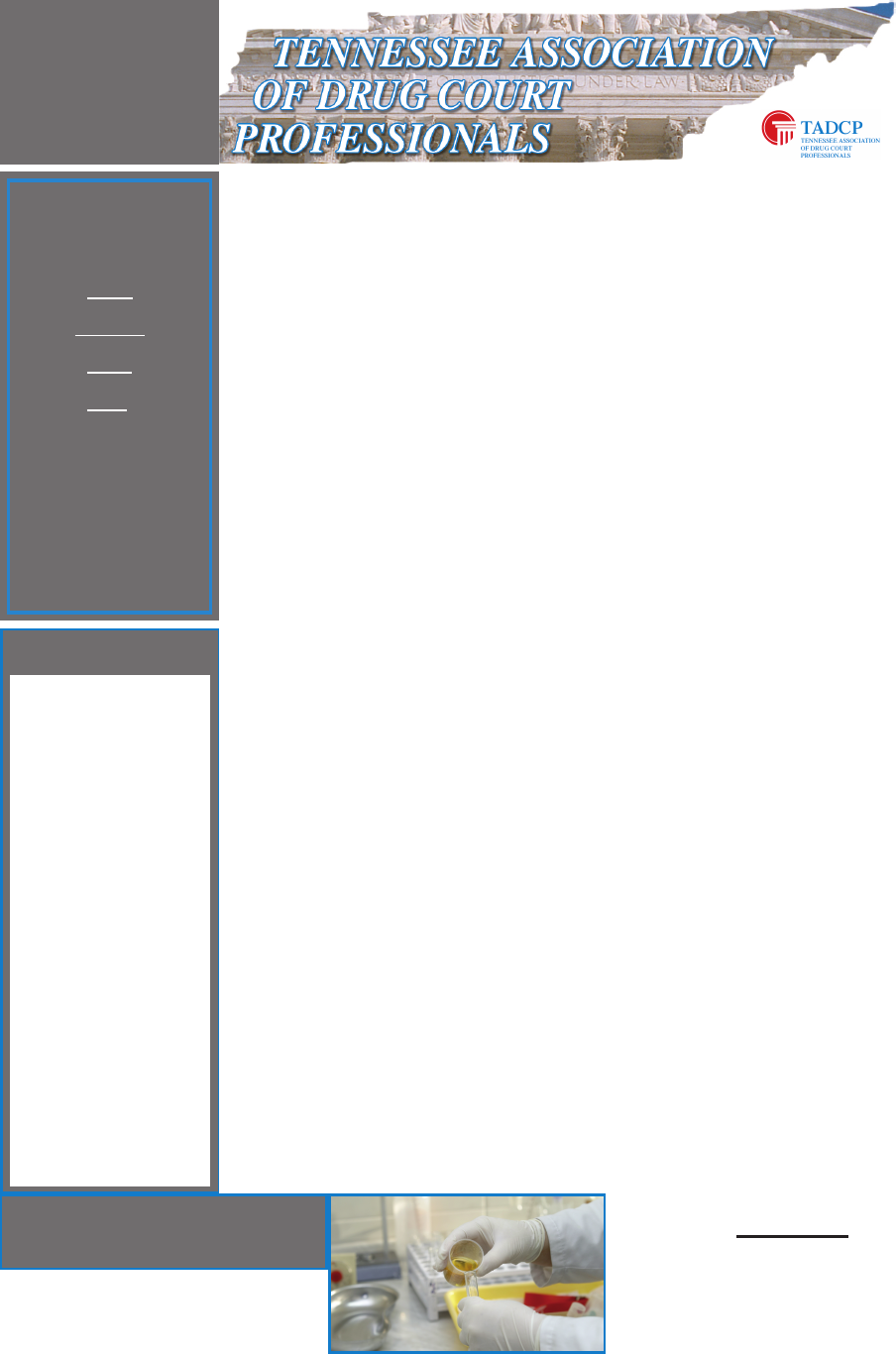
The screen itself should be accurate,but it is important to recognize that accuracy does not mean 100%.
Page 2Tennessee Association of DrugCourt Professionals
TADCP U
PDATES
A F
EW
N
EW
F
EATURES
T
HE
TADCP W
OULD
L
IKE
T
O
S
HARE
W
ITH
Y
OU
B
EYOND
R
HETORIC
: W
HEN
M
ULTIDISCIPLINARY
T
REATMENT
T
EAMS
M
AKE
A D
IFFERENCE
D
ONALD
G. J
ORDAN
, LMSW &D
AMIEN
N
ETHERY
, LCSW I C
ITY
C
OURTOF
J
ACKSON
, TN •
WWW
.
DRUGTREATMENTCOURT
.
COM
TADCP has a few new features to sharewith you! In an effort to make applying formembership easier, we have created a fillableform that you can access through our websiteor through email (just ask me to send it toyou). If you are not a member and would liketo be, or if you just want to check it out, theform is located on our website on the topmenu under Home>Membership>GeneralInformation. You may also access it at thislink https://www.tadcptn.org/membership/. There’sless duplication completing this form for arecovery court team, and you can easily print itout and send it in with your payment. Whenyou submit the form, it comes right to me! We continue to work on the new website,and have big, BIG, plans for it this year. It isour mission to make the TADCP website asclose to a one-stop-shop as we can forTennessee Recovery Courts. We have a com-mittee working on layout and content, so if you have ideas feel free to email them to[email protected]. Updates to thewebsite already include a Google map of theadult, juvenile, and family drug courts to makeit easier to identify them by location. Thedirectory is still there and it has more detailedinformation than the maps do. We will addother recovery court maps to the page soon.When you have a few minutes, please check itout! https://www.tadcptn.org/business-directory/find-a-tennessee-recovery-court/. We are pleased to announce that we alsohave a very new TADCP BLOG. We’ve beenadding content for several months now, andhave recently provided an opportunity for youto sign up to receive an email alert when wepost a new one. Our goal is to provide rele-vant, useful material for you as a professionallinked to recovery courts or in a related field.Please go to our website and sign up today! Tomake it a cinch, here’s the link:https://www.tadcptn.org/tadcp-blog/! Check out thecontent thus far to get an idea of what we aredoing. Our Platinum Members, Drug TestingProgram Management and ThermoFisher willbe guest bloggers this year. If you would liketo help us with blog material by sharing some-thing about your recovery court with us, pleaseemail me! The BLOG can be especially usefulif you’d like to get the word out about some-thing that’s happening before the next newslet-ter. If you don’t already know, we have aFacebook page, Tennessee Association of Drug Court Professionals. Facebook users,PLEASE go to our page and ‘like" us! Weregularly share news and other recovery courtrelated updates, or we post pictures of eventswe’re attending. It’s also a great place to con-nect with each other and post about yourrecovery court’s events. We would all love toknow and celebrate with you if you have afundraiser or other special event, so SHARE!If you are on Twitter, please add us to yourfollow list. We are T[email protected].TADCP (and Marie) is new at this, but we aretrying, hard, to find ways to connect with you,and to connect you with each other so that wecan share information and resources in a quick and user-friendly way. Trained as a Social Worker, I was taughtwell that a multidisciplinary approach wasalways preferred. I was taught that no matterthe added difficulty of getting individuals withdifferent personal perspectives and profession-al frameworks together with clients when col-laborating toward treatment planning, it isalways in the best interest of the client, thegroup and the community. As usual in the epic chasm between acade-mia and practice, some things sound better intheory than they are experienced in reality.Perhaps no one would naturally assume that atreatment team of Drug Treatment Court in asmall, rural West Tennessee town would beany different. The conference room table ishome every Thursday afternoon to a racially,educationally, generationally, socially andvocationally diverse group. Attorneys, SocialWorkers, Medical Doctors, Recovery Veterans,Executives, Professors, and Drug TreatmentCourt alumni sit around a small table just out-side of the courtroom proceedings. Interviewsare held, sanctions and incentives are dis-cussed, trainings are provided, best practicesare reviewed, and somehow the work isaccomplished week by week. The motley and talented crew that makes upour Treatment Team would be unlikely to formconsensus on much. And in this very reality isfound the secret to the multidisciplinary teamin Drug Court. Within the last month, referralshave been accepted and denied due to eachmember of the treatment team speaking up andadding value and insight to the discussionbefore consensus is reached. Informed dis-agreement and discussion springs from differ-ing backgrounds, professions and seasons of life resulting in better decisions and thereforebetter outcomes. In one case, a clinician mightspeak to the affect and mood of a client beingproblematic, changing the decision of theteam. In another instance, an attorney assists aclient in fully understanding his legal choicesfor the first time, affecting his desire to partici-pate. The bleeding heart of a student internhelps facilitate better-explained thoughtprocesses and decision-making. These deci-sions with the input and support of our judgehave facilitated a ten-year-old program boast-ing great results across fiduciary, therapeuticand restorative success standards. Were the treatment team to consist only of social workers, only of those in recovery, onlyof those in the legal profession, or only thosein mental health, law enforcement or criminal justice, each decision would reflect a strongbias unworthy of human complexity and digni-ty. In the City Court of Jackson Tennessee,when the Treatment Team sits around a smallconference room table just outside of thecourtroom proceedings, the value of multidis-ciplinary teams is made clear. And both peopleand community find recovery.
If you don’t already know, we have a Facebook page, Tennessee Association of Drug Court Professionals. Facebook users,PLEASE go to our page and “like” us!
T A D C P
E
VENTS
Mark Your Calendars!
2014 NADCPConference
December 3-5, 2014
EmbassySuites &Conference CenterMurfreesboro, Tennessee
Registration Information Coming Soon!
Page 3Tennessee Association of DrugCourt Professionals
TADCPM
EMBERS
E
NJOY
....
B
Y
M
ARY
S
CHNEIDER
•
C
ONTINUING
E
DUCATION
O
PPORTUNITIES
(NAADAC
AND
CLE)
•
A
NNUAL
TADCP C
ONFERENCE
•
Q
UARTERLY
N
EWSLETTER
•
R
EPRESENTATION THROUGH THE
TADCP L
EGISLATIVE
C
OMMITTEE
•
F
REE AND
D
ISCOUNTED
T
RAINING
O
PPORTUNITIES
May was National Drug Court Month and wealso celebrated the 25th Anniversary of DrugCourts. I hope many of you took advantage and putyour drug court in the spotlight in your community.The 16th Judicial District Recovery Courts hadtheir annual picnic on May 22nd, which is alwayswell received by staff, participants and alumni.Then on May 29th, we all got together and did aClean Up Day and cleaned up trash on our commu-nity’s greenway trails. This was our way of givingback to the community that has done so much forus, and also allowed us to get a little publicity.Please let us know what your courts did to cele-brate!25th Anniversary of Drug Courts! Amazing!Who thought it would take off like it has andbecome such a success? Because of Drug Courtsmany states are looking at their criminal justice sys-tems and making changes that make more sensethan throwing people in jail. States are actuallyclosing prisons because of drug courts’ success! Iwould like the state of Tennessee to make better useof drug courts and encourage the growth of drugcourts financially. I know the Governor is doingthis to a certain extent. But all parties in theCriminal Justice System need to sit down at thetable and include drug courts in the continuum of care that can relieve our prisons and local jail sys-tems. Texas, New Jersey and California, to name afew, are providing models to other states on how tobest utilize drug courts. Governor Haslam andCommissioner Varney need to look to these statesto see how it is done, and done well.Yes, we have come a long way in this state, butwe could be so much better and smarter with thetaxpayers’ money. TADCP will continue to advo-cate for drug courts and for you, our members. Butwe always need your help. Writing letters and vis-iting our legislators is always time well spent. Theydo listen to us! Thank you for your support!
Regards,Mary Schneider, LAPSW
T
HE
P
RESIDENT
’
S
C
ORNER
The Tennessee 2014 Recovery CourtCoordinator Training is scheduled forJune 10th – 12th at the MainStay Suites inPigeon Forge. This is a very nice facilitythat has just undergone a total renovation.You can visit the website by going to:http://www.mainstaypigeonforge.com/. Ihope everyone who is planning to attendwill enjoy the mountain views and all areahas to offer.This year’s training will start with anafternoon session covering the Evolutionof the Addicted Brain,Medication Assisted Treatment, and theOpiate Addicted Pregnancy presented byDr. Stephen Loyd. There will also be ses-sions on Veteran Benefits, Oxford House,Criminal Thinking in addition to paneldiscussions on Creative Housing, Pros andCons of Non-Profits and Foundation andthe Definition of Violent Felonies. Thisyear’s training follows the NADCPConference in California where they willbe disseminating the next 5 Best Practicespublication. I’m sure they will also be atopic for discussion. There will be net-working opportunities, updates fromLa’Tray on the PS Court TN -WITs datasystem and I will have a bit of time to dis-cuss TDMHSAS business before closingthe training. A BBQ supper with all the fixins willbe on Tuesday night. Many of you arebringing family members and I look for-ward to meeting them. Hopefully theweather will cooperate so we can enjoythe outdoors under the Pavilion beside thecreek that runs through the property. TN WITS UPDATE – The long awaitedfees section is up and running! Please useit and let La’Tray know if there are anyissues. She will be distributing updatedPS Court TN-WITs TIP Sheets soon thatwill include the many changes and dataelements that you have requested to beadded to the PS Court module. As wehave said many times, "this is a work inprogress" and continues to be a "work inprogress". We do appreciate your feed-back and recommendations.I look forward to spending time withyou and listening to what each of you hasto share. If you have any questions orneed assistance please contact me at 615-532-3411 or [email protected].
2014 R
ECOVERY
C
OURT
C
OORDINATOR
T
RAINING
L
OOKING
F
ORWARD
T
O
S
EEING
Y
OU
I
N
T
HE
M
OUNTAINS
June 10 - 12th MainStaySuites in PigeonForge